

The Benefits of Paper-Based Learning for Primary School Students

Updated: Oct 7
Does the medium (screen or paper) alter how children process, retain, and apply information? Empirical research consistently shows that tactile, paper-based learning yields superior comprehension, longer focus, and lower cognitive fatigue, particularly among primary school children in Years 1–10.
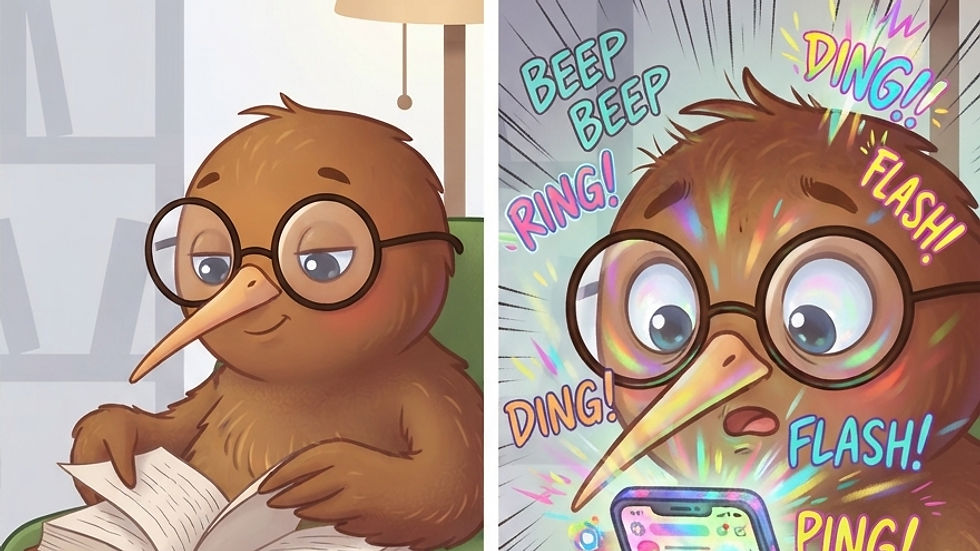
Today, we explore the cognitive science behind digital versus paper-based tutoring. This will help parents navigate issues such as screen fatigue and short attention spans when making choices about after-school learning.
What the Research Says About Screen Time and Attention Spans
The 'screen inferiority effect' is a well-documented finding. It shows that reading or processing text on digital screens leads to poorer comprehension, shallower analysis, and quicker task switching than with physical print. When children interact with fast-paced screen stimuli, their brains trigger frequent micro-hits of dopamine. This makes the sustained, linear thinking required for maths problem-solving and deep reading much harder to maintain.
Digital Overload: Between digital whiteboards at school and tablets at home, children spend hours absorbing hyper-stimulating media. This puts a strain on working memory and accelerates mental exhaustion.
Impact on Concentration: Constant notifications, pop-ups, and rapid scrolling train the brain to seek immediate stimulation. This damages the sustained focus required for academic success.
The screen inferiority effect shows that reading on a screen leads to poorer comprehension and weaker long-term memory than reading physical print. Fast-paced screen stimuli trigger frequent spikes in dopamine, which shortens children's attention span for complex academic tasks.
The Cognitive and Neuroscientific Benefits of Paper-Based Learning
Tactile learning is an offline educational approach. It uses physical printed worksheets and handwritten problem-solving to improve understanding, spatial awareness, and memory retention, free from digital distractions.
Spatial Memory and Layout: Physical paper provides tactile anchors, such as page location, margins, and the act of physically turning pages. These help the brain build 3D mental maps of information, improving long-term recall.
Motor-Brain Encoding: Handwriting activates complex fine motor neural pathways. This reinforces spelling, syntax, and letter or number recognition far more effectively than typing or clicking.
Reduced Distraction: Paper offers a calm, closed environment free from notifications, pop-up windows, and the temptation to switch tabs.
Physical pages enable spatial mental mapping, helping young learners securely anchor information in their long-term memory. Sensorimotor integration through handwriting activates neural pathways that are critical for multi-step reasoning and literacy.
Screen vs. Paper Tutoring: A Direct Comparison
A comparison of digital software tutoring and paper-based, face-to-face instruction reveals stark differences in terms of focus, retention, and wellbeing. For example, in-person tutors can observe physical pencil movements and subtle body language, which automated screen apps entirely miss.
Metric | Digital / Online Tutoring | Paper-based In-person Tutoring |
Comprehension Depth | Often shallow due to skimming, hyperlinks, and rapid task-switching. | High, supporting deep reading and analytical thinking. |
Retention Rate | Lower long-term recall; prone to digital fatigue and distraction. | Superior due to spatial mapping and motor-brain encoding. |
Distraction Risk | High (notifications, tabs, pop-ups, and the device itself). | Zero (in a closed, screen-free physical environment). |
Tactile Engagement | Minimal (typing, tapping, clicking). | Maximum (handwriting, page-turning, and physical problem-solving). |
Paper-based tutoring is more effective than digital platforms at maximising retention depth and eliminating environmental distractions. In-person guidance enables real-time emotional and cognitive adjustments that automated apps cannot replicate.

How to Know If Your Child Needs an After-School Tutor
When deciding whether to seek external support, it is important to look out for specific academic red flags rather than temporary classroom hurdles. Parents should look out for these clear indicators:
Consistently struggling with foundational concepts in Maths or English.
Homework-related friction, avoidance, or emotional distress during evening routines.
Falling behind the school curriculum due to distractions in the classroom or learning gaps.
Low self-confidence or a shift towards a fixed mindset ("I'm not good at this").
Give Your Child the Right Learning Environment
At Learning Club Takapuna, our teaching methodology is intentionally aligned with cognitive research on how children learn best. Designed for Years 1–10, our Maths and English programmes are 100% paper-based and screen-free.
By eliminating digital distractions and providing personalised, face-to-face guidance in small groups or one-to-one sessions that align with the New Zealand Curriculum, we help local students build solid foundations, improve memory retention, and boost their confidence in learning. We offer free diagnostic assessments and flexible weekly passes with no lock-in contracts.
Find out more by exploring our approach in our 'How It Works' guide.

Comments